


It’s funny how life works.
When you’re hoping a community will help you out of the hole you’ve become stuck in, they don’t seem to be there.
But, one day you remember the way out, you claw your way out alone, and there they are waiting for you.
They flood the hole with aroha,
it can be overwhelming,
you consider returning into the hole.
Then one of them says, “Where have you been kare?”
You see that you were the hole, and you allowed yourself to get stuck in your own head, isolated, alone, you didn’t reach out to the community you were waiting for, and they didn’t realise you needed them, they were always near… waiting for you to come back.
You look and see they are still waiting for you to answer.
You decide you could answer, “Oh sorry! I’ve just been so busy, ya know?”
or, …
you can let them in.
When Heidi reached out wanting to change her solo to a group show to create herself a new community in Pōneke where she’d recently moved to I was grateful to be asked to be part of her community and equally that she would now be part of mine.
Matariki this year has been an extremely tough and significant one. The waka, Te waka o Rangi, captained by Taramainuku has found this last year unrelenting, as Taramainuku casts his net Te Kupenga a Taramainuku down to earth to gather the souls of the people who died each day the net overflows with our loved ones. Some souls who were ready, but far too many who were not.
Needing community has never been so necessary.
These works are dedicated to those souls and the communities that mourn them.
2x
Title: From all rivers to all seas
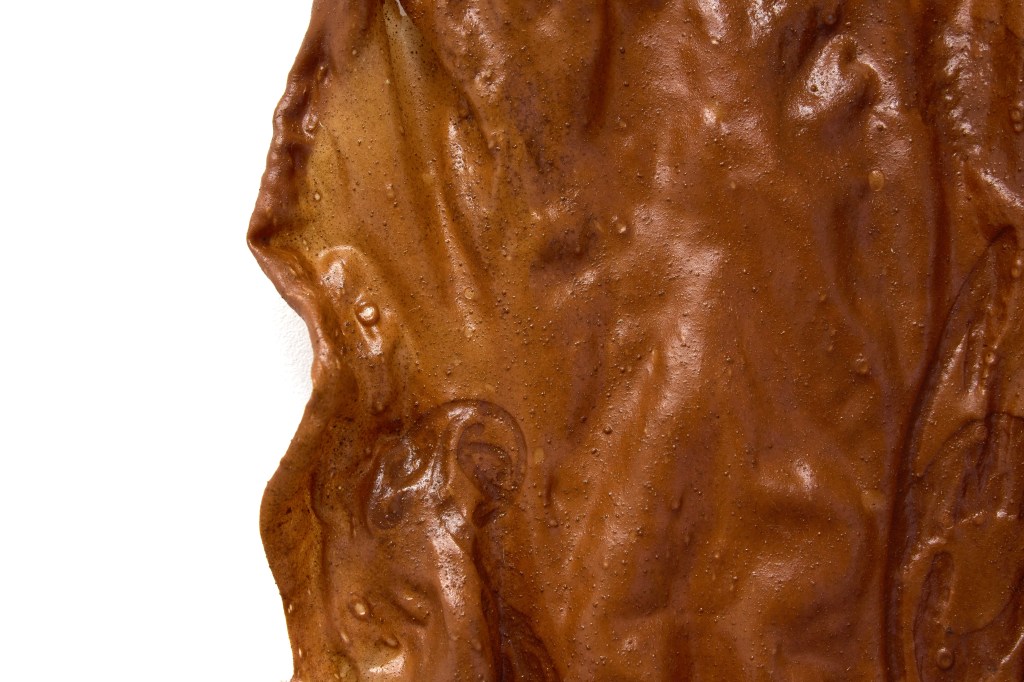
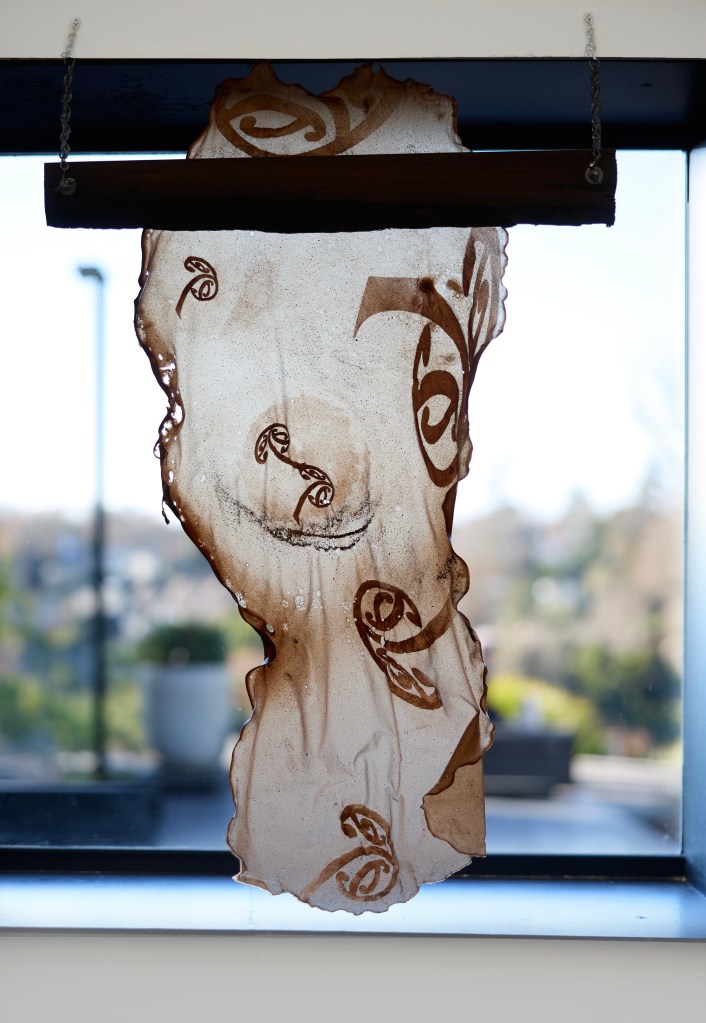
Material: Kirihou Māori Bioplastic made from Wai (Water from Te Awa Kairangi/the Hutt River), Kōkōwai (Red Ochre from Te Rerenga Wairua, Cape Reinga), Pūtauhuka (Cellulose from tree bark) , Wē parāoa (Whale oil from stranded Spermaceti whale Puhiwai Rangi)
1x
Title: Waikato taniwha rau
Material: Kirihou Māori Bioplastic made from Wai (Water from Te Awa Kairangi/the Hutt River),Whenua (soil from the Steaming cliffs in Waikato), Pūtauhuka (Cellulose from tree bark) , Wē parāoa (Whale oil from stranded Spermaceti whale Puhiwai Rangi)
Dedicated to the lost whakapapa of Palestine and the Waikato.
Part of the article written by Heidi Brickell for the Hā Tua magazine “Kirihou, new skin, or to be precise bioplastic, developed by Tessa Russell via a practice embedded deep in connection with the soil, and that restlessly pursues invention and collaboration towards a renewed world. Comprised of whenua and tree bark cellulose, Russell’s springy bioplastic films hang friendly and alive, untrimmed to resemble another pre-existing form, but dancing subtly and resiliently as interpreters of the daily weather. On a humid day they nuzzle exploratively into the corners of window sills instead of answering to the gravity of the floor, and flop dramatically over their wooden supports, only to stand spritely like a kitten’s tail again when the moisture clears from the air. Their flexibility and potential as a sustainable technology proclaims its material sovereignty via cheeky antics and defied expectations of how a material should act.
Imprinted like earthen moko that absorb light like chocolate truffle dusting that cleanly contrasts the translucent skins they pucker against, are mangopare forms that float. Commonly seen descending down the hekerangi of a wharetipuna in unbroken lines from the sky to the heads of the pou whakairo, representing tangata whos feet are planted on Papatūānuku, these ones float, rhythmically, but broken apart. In these severed lines, there is both a mourning, a lament, and a frenetic energy that keeps on seeking connection and momentum.”
 TOI BY TESSA